Recovery of Saline Water from Reactive Dyeing Processes for Reuse
Reactive dyeing processes in textile dyehouses generate hot process water containing high concentrations of salt. When assessed in terms of salt content, process water quality and temperature, these streams offer significant potential for water, salt and heat recovery.
An Approach That Transforms Hot, Saline Dyeing Process Water into a Valuable Resource for Production
As part of TÜBİTAK-supported R&D activities, VERİTAS ÇEVRE has developed a specialized recovery technology that enables hot, high-salinity process water from reactive dyeing operations to be reused in production.
The developed process manages color and contaminant loads in saline water and brings it to a quality suitable for reuse in dyeing. Water, salt and thermal energy are thereby recovered together and returned to the production process.
This integrated approach reduces the need for fresh water and additional salt while helping retain the thermal energy carried by hot process water within production. By combining water and energy management in one process model, it supports resource efficiency, wastewater management, energy performance and industrial green transformation goals.
Results obtained from validation studies conducted in dyehouse laboratories were reported during the TÜBİTAK project.
Within the same process stream, we preserve the value of water, salt and heat together
Hot, high-salinity water from the dyeing process is treated not merely as wastewater, but as a process resource whose water, salt and heat value can be preserved together.
Process Water Recovery
By controlling contaminant and color loads, dyeing process water is treated to a quality suitable for reuse in dyeing, helping reduce fresh water demand.

Salt Recovery
By retaining salt from the reactive dyeing process, the system aims to make use of its remaining value when recovered water is reused and to reduce the consumption of additional salt.

Heat Energy Recovery
Thermal energy carried by hot process water is retained and incorporated into the reuse cycle, helping reduce reheating needs in production and improve energy efficiency.
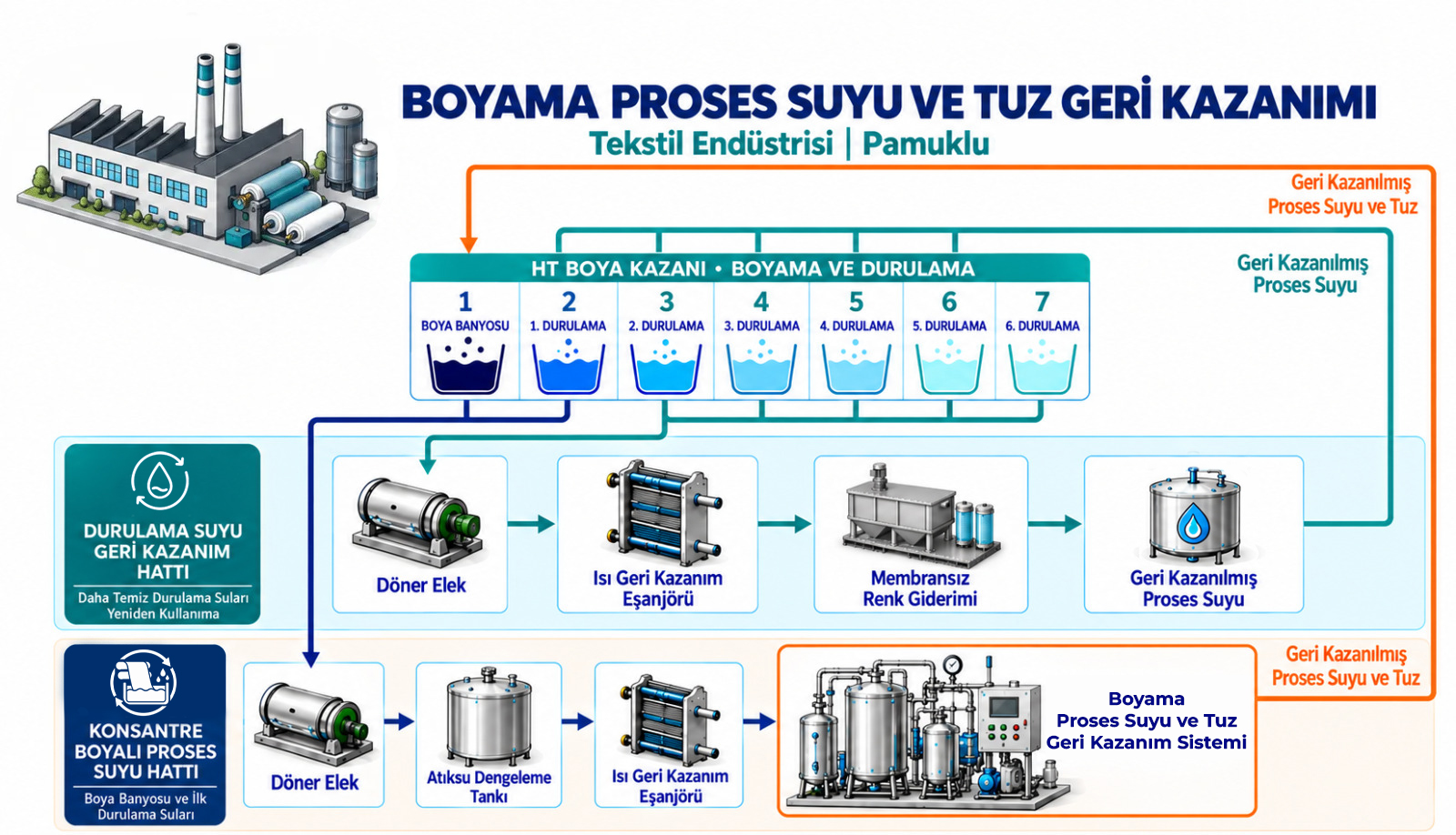
From dyeing to reuse: the water, salt and heat cycle
The flow diagram illustrates the overall approach to managing contaminant loads in hot, saline water from reactive dyeing and returning it to production.
A process approach developed through R&D and laboratory validation
R&D studies and validation tests conducted in dyehouse laboratories achieved >85% salt recovery, >90% water recovery and >90% heat energy recovery. The results were reported during the TÜBİTAK project.
While managing contaminant and color loads in hot, high-salinity water, the process aims to retain recoverable resource value within the production cycle as much as possible.
Integrated management of dyeing and rinsing water
The rinsing water recovery systems implemented by VERİTAS ÇEVRE at industrial scale are being expanded to include the recovery of hot, high-salinity water generated during dyeing.
Field experience in rinsing water recovery is being transferred to this new technology through process control, automation, equipment sizing and system integration. The water, salt and heat recovery potential of the dyeing and rinsing stages can thus be assessed within an integrated recovery model.
